I'm a sucker for 70s psychedelic groove, so as soon as my friend Daniele from Killer Groove Records (who works with Atabasca) told me about Electric Circus, I knew there was something cool coming my way.
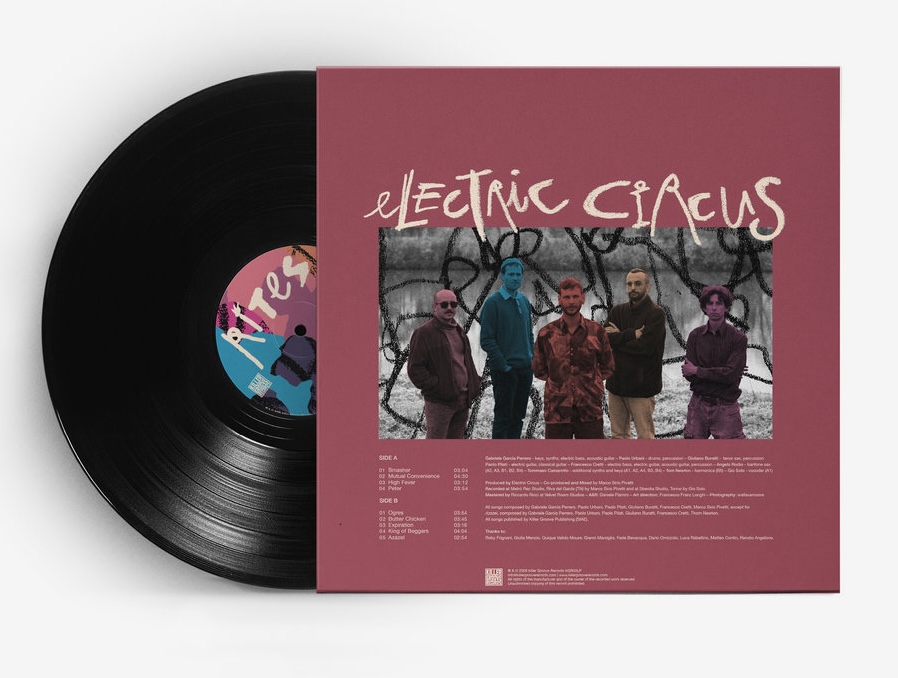
The Italian collective just released their album Rites - a record that feels like the soundtrack to a film that exists only in your imagination. Out November 27th, the album draws inspiration from vintage crime soundtracks, library music and psychedelic grooves, blending them into a colourful, cinematic journey. I had the pleasure of catching up with the guys last week and talk about the recording process, inspirations, and whatnot.
Hi guys, so happy to have you here! Can each of you quickly introduce yourselves?
It's our pleasure. The original core members are Paolo Urbani (drums), Paolo Pilati (guitar), and Francesco Cretti (bass, guitar). They were later joined, in this order, by Giuliano Buratti (tenor sax), Gabriele Perrero (keyboards, bass, guitar), and Angelo Rodio (baritone sax).
You seem united around the shared love for groove rather than any particular genre. How did the band come together, and what was the original musical idea behind it?
Stay up to date.
New music and exclusive updates in your inbox weekly.
That's true, we definitely share a love for groove and certain musical genres, but above all, we do it for the love of music. Each of us comes from a different background, with our own tastes, influences, and experiences. Electric Circus is the result of all these different elements coming together, with everyone bringing something personal to the mix, which isn't predetermined but rather takes shape naturally as we go along.
Congrats on the album release! How did the recording process look, and how did it differ from your previous album, Canicola?
They were actually quite different, as Canicola was recorded entirely in one week, and we tried to keep overdubs to a minimum. Rites, on the other hand, was recorded in multiple sessions, over the course of several months between Riva del Garda and Turin. Even so, we didn’t want to lose the core of our interplay: the foundation of each track (bass, guitar, drums and keyboards) was recorded live, all together in the room. From there, we made the most of the endless sonic possibilities available to us, adding the occasional overdub but above all taking care of the sound itself, reamping, experimenting with analog effects and adding details and textures, like percussion, to bring each track closer to the sound we had in mind. Underneath it all, though, the groove still has that live, played feel.
How did you pick the name for the record, Rites? The title suggests rituals, repetition, and perhaps even something spiritual. What does it represent to you, and how does it connect to the music?
The title came to us rather quickly and essentially reflects the compositional approach we took for this record. The long sessions of thematic and sonic development, driven by the steady pulse of the groove, may in some ways evoke a ritualistic dimension in which individuals find a collective aspiration that guides their actions and brings them together.
If Rites were a film, what would its opening scene look like? And more importantly, what would be playing in the background?
The album opens with Smasher, a track with a retro funk vibe that has always made us picture Miami's beaches at sunrise. That's the setting, and the opening scene would be a drive through the city's wide boulevards, past skyscrapers reflecting the soft pink glow of dawn, with the city lights still illuminating the streets of this neon-lit 'Vice City'.
The DNA of Rites is wonderfully eclectic: '70s jazz-funk, afrobeat, Ethiopian scales, dub, library music and psychedelic rock. What are some records that have been on heavy rotation in your homes or record players over the past couple of years?
Some of the albums we’ve been listening to lately include Herbie Hancock’s work with the Headhunters, the Heliocentrics’ albums featuring Mulatu Astatke and Orlando Julius, and Weather Report’s Black Market and Heavy Weather. Those have definitely been primary and very direct influences on Rites, along with the raw funk of The Meters and James Brown. Another source of inspiration, though less prominent on this record, is music that evokes the desert. We’ve always been drawn to the minimalism and hazy, open-ended atmospheres of Calexico’s early albums, as well as the Tuareg grooves of Tinariwen and the music of Malian artists such as Boubacar Traoré and Ali Farka Touré. These influences were much more central to On est ensemble, the EP we recorded with Sahel Roots, but even though we took a different direction with Rites, some of that musical sensibility still carries through.
How do you decide when a track is finished? Especially when you're working with improvisation, psychedelic textures and layers that could potentially keep evolving forever.
We try not to cram too many ideas into a single track, and we generally work within the song format to avoid becoming too long-winded. It's also worth noting that this album represents the culmination of a creative phase that began nearly ten years ago with Canicola, so we had a fairly clear idea of the sound we wanted and the overall structure of the tracks. Since then, the approach that has guided us is to build musical scenes, using sounds the way you’d use paint or a pencil. A track feels finished when we can see the whole scene in our heads, with its own image and colors, whether it’s something abstract or something more concrete.
I love the album’s artwork. Such a nice complement to the psychedelic nature of the record, which will also be on vinyl. How important is the physical format to you as music lovers and collectors? Do you think this adds to your relationships with your fans?
We'll pass your compliments on to the artist, Franz Longhi. For us, a physical release is a way to feel even closer to an artist and fully appreciate their vision, as well as a tangible way of supporting them. We love connecting directly with our fans, and one of the places where that happens is at the merch table at our shows. We're always genuinely moved when someone decides to support us by buying something that represents the work and passion we've put into our music.
There’s a rise when it comes to that trippy psychedelic blend of 70s jazz funk and Afro-inspired beats. Why do you think that is, given there’s so much new music all the time? Are people tired of that contemporary overabundance and seeking back some origins?
Obviously, it's not easy to interpret a sociological phenomenon while it's still unfolding. For well over a decade now, projects built around funk- and Afro-influenced grooves, as well as hip-hop and neo-soul, have been attracting considerable interest. From a musician's perspective, these styles naturally lend themselves to cross-pollination (since they're hybrids to begin with) and are built around a strong rhythmic drive that supports a melodic and harmonic language rooted in blues and jazz. These characteristics allow musicians to express themselves through a hybrid musical language grounded in shared traditions, while giving audiences something they can dance to. Rather than a return to the roots, we see this phenomenon as part of a broader movement of discovery and rediscovery of dance music of African and African American origin.
What advice would you give to any starting young band?
We certainly don’t feel we’re in a position to give anyone advice; on the contrary, we’d be more than happy to receive some if anyone’s willing to offer. For us, dialogue matters far more than putting ourselves in a position where we have something to teach. That also reflects the way we make music: there’s no leader or frontman in the band, and no one really stands out. It’s all about how the different parts blend together. So if there’s anything we can offer, it’s probably best picked up by watching us on stage and listening to our music.
If you could curate a festival lineup featuring five artists, living or dead, who would share the stage with Electric Circus?
The Heliocentrics, Herbie Hancock, Weather Report, Fela Kuti & Africa '70, Area.
What inspires you outside of music, in your everyday lives?
Inspiration can come from pretty much anywhere, whether it's a conversation, a place we've visited, or something completely unrelated to music. We all have different interests and experiences, and they inevitably find their way into what we create. But if we had to narrow it down, we'd probably say the mountains and forest landscapes we grew up surrounded by in the Italian regions of Trentino and Piedmont. Whether or not they directly inspire our music, they've certainly shaped who we are.
Who is on your playlist - any other bands we should be listening to right now?
Our musical tastes are pretty diverse, so there's always something different playing in each of our homes. Lately, some of us have been particularly drawn to flamenco, with Yerai Cortés being one of the more contemporary examples. We've also been listening to musicians like Yamandu Costa, whose unique guitar style draws on Brazilian traditions such as choro and samba. We really appreciate how artists like these draw on musical traditions to create something deeply personal and original. Closer to home, we've had Cheyenne's latest record on repeat. They're a talented up-and-coming Italian band with a fresh approach to contemporary jazz and a knack for creating immersive, dreamlike atmospheres. We definitely recommend checking out their latest album.
What's next for Electric Circus?
Over the coming months, we’ll be playing a few shows around Italy, including our album release show in Turin on December 18. We’re also looking forward to the final of the Premio Buscaglione Jazz, a prestigious Italian jazz award, which will take place as part of the Torino Jazz Festival programme. It’s an important opportunity for us: we were selected from more than 100 projects, and we’ll be sharing the stage with three other bands. We’ll also be hitting the road for more shows next year, so make sure to follow us on social media to stay up to date with our upcoming gigs. In the meantime, we’re ready to kick off a new creative phase and cook up a whole lot more music.
Thanks for stopping by! And for the great sonic experience.
Thank you for having us and for listening.