Generative AI has entered the creative world like a tide appearing on the distant horizon – it’s difficult to determine the heights it’ll reach as it stretches towards the shoreline. One thing is for sure though, the question is no longer whether it will arrive, but what the coastline will look like afterward. With all three major labels recently forging relationships with AI music companies - Sony Music with Klay, Warner Music with Suno, and Universal Music Group with Udio - the direction of travel is becoming increasingly difficult to ignore.
With that being said, the potential for this tide to turn into a flood is quite high. We’re still in the early days, and for many, it’s already incredibly difficult to distinguish between generative AI and human-made music. Luckily, there are a couple of tell-tale signs that would notify you that what you’re listening to isn’t actually made by a human. Throughout this article, we shine a light on and offer a definitive guide to identifying AI music. Across all of our curation platforms, thousands of submissions pour into Stereofox from every corner of the world each week. A sizable chunk belongs to the incoming tide of generative AI music, and by now, we've developed an ear for the subtle signs that separate human expression from machine generation. So you’re in good hands; think of us as a lighthouse in the midst of the AI tsunami. Let’s get started!
The AI Policy of Each DSP
Before diving in, I'd love to just quickly highlight something. Music streaming services have essentially become the digital gateway to listen AND store music for the masses. Today's major DSPs broadly fall into three camps regarding AI music: the stern detectors (Deezer and Qobuz), which actively identify AI-generated content; self-disclosure platforms (Apple Music and Spotify), which rely on metadata and creator declarations; and hardliners (Bandcamp), which completely ban generative AI music on their platform. In Tidal's case, they have declared that AI-generated music is blocked from earning royalties. There is no consensus across the board on how to approach labeling and identifying AI music from the platforms we consume music from. Here is a quick overview of the above:
Spotify
In a nutshell, the Swedish company's approach regarding AI is to label and limit, not block. Spotify now labels artist profiles that represent AI-generated identities and excludes them from editorial, algorithmic, and personalized recommendations automatically. To be more specific, the label is about the profile's public identity, not about how the music was made.
Deezer
Deezer takes a different route. Detection and labeling serve as the base layer of their policy, since fully AI-generated tracks are tagged and excluded from recommendations. Furthermore, it excludes these tracks from recommendations and playlists, demonetizes streams that seem fraudulent, and now also removes tracks that are used for streaming fraud.
Stay up to date.
New music and exclusive updates in your inbox weekly.
"First and foremost, we want to give our users the choice to listen to AI-generated music if they want to. It is not up to us to make the decision whether it’s good or bad, especially with AI becoming more and more common as a tool across the music industry. And an outright ban comes with a set of challenges. The detection and tagging are automatic due to the fact that we are receiving roughly 90,000 tracks per day, and it’s impossible for us to manage this manually. We have no way of knowing whether or not these tracks are from established artists that have used AI tools to render tracks that they sing or rap over, for example. So if we automatically removed all tracks detected as AI-generated, we would not only give people less choice, but also run the risk of removing music that was created through genuine creativity by human artists, but happens to include enough AI-generated elements to be detected by our tool." - Aurelien Herault (Chief Innovation Officer over at Deezer)
Bandcamp
Bandcamp has the strictest approach, as it bans music made entirely or even substantially made with AI, instead of labeling or limiting it."Keep it human" sits at the core of their policy. It relies on fan reports and human review instead of automated detection and labeling. Bandcamp also blocks scraping of its catalog for AI training.
TIDAL
TIDAL's approach sits between Deezer's and Bandcamp's: it allows fully AI-generated music but it isn't monetized, and it removes AI music tied to fraud or impersonation. An "AI" badge is also placed on AI tracks, while AI music that impersonates artists or is tied to fraud gets removed.
"We’re working with an industry-leading external partner that detects when tracks are made with an AI platform. We label tracks that have a high probability of being wholly AI-generated. This provides transparency so listeners understand what kind of content they are listening to. Listeners can also turn off AI tracks in their app settings. Once off, AI-labeled tracks won't play, and they will also be removed from personalized recommendations as they're refreshed" - Robert Andersen (TIDAL Lead)
Apple Music
Apple Music's approach is disclosure-focused. It requires labels and distributors to tag AI use and will soon show a "Made With AI" label to listeners, but it doesn't ban, demonetize, or demote AI music. The tags are best understood as groundwork for future policy rather than a restriction in themselves.
Why It's Important to Separate AI Music from Human Music
For listeners, why it’s important to distinguish the two boils down to ethics around transparency and our perception of "authenticity". Clarity allows people to make informed choices about what they consume. It’s no surprise why some feel duped after finding out a piece of music they enjoy is generated by a machine. A 2025 study indicates that when listeners are played identical pieces of music, simply labeling a track as "AI-made" causes participants to rate it as significantly less moving, less profound, and lower in aesthetic value than if it is labeled "human-composed." We subconsciously value the perceived effort, narrative, and lived experience behind a piece of music. The conversation becomes far more complicated when some creators maliciously go out of their way to conceal the use of AI and present the music as the product of human artistry alone.
"Generative AI has made it easier than ever to commit streaming fraud. Anyone can very quickly create thousands of tracks, upload them to multiple streaming platforms, artificially boost the streams, and this way take money from the royalty pool that would otherwise end up with legitimate artists." - Aurelien Herault
For artists, this is a critical necessity for creative survival. Deepfakes and other types of unauthorized AI voice models have become popular over the past few years. This means artists (especially with a sizable following) should be hyper-vigilant about protecting their own likeness and sonic brand. Identifying when your voice or signature production style has been scraped and generated without permission is a legal matter that needs attention.
AI models are (predominantly illegally) trained on vast datasets of existing music, and labels, publishers, and artists usually argue that this is illegal and infringes on copyright laws. This has the potential to escalate, as this introduces the risk of unintentional copyright infringement if the algorithm reproduces a protected melody or chord progression a bit too closely.
The Importance of Curators In the Age of AI
As more AI-generated music gets uploaded to streaming services, the more essential human curation will become. According to a survey by Deezer, 97% of people cannot differentiate between fully AI-generated music and music made by humans. Listeners can't reliably sort the flood themselves, and algorithms that optimize for engagement or volume can seamlessly be gamed by content farms. Curators, be it editors, tastemakers, labels, or fans, can provide context and accountability that a ranking or detection system cannot. They tell listeners who made something and why it matters, and they steer attention and money toward artists building real careers through the stories, instead of toward whoever can upload the most tracks.
7 Ways to Spot AI Music
- Artwork
- Digital Artifacts
- Lyrics Feel Like Word Salad
- Lack of Social Media Presence and Live Performances
- An Extremely High Level of Output
- Extreme Genre Changes Without Credits
- Vertical Wall Data
Artwork
The first giveaway is often visual rather than sonic. Usually, AI artwork is far easier to recognize than the music itself, and there’s a strong correlation between artists using AI-generated covers and AI-generated music. Industry reporting suggests that a majority of today's fully AI-generated music comes from casual users who upload in bulk using platforms like Suno and Udio, not from artists using AI as a tool. These users often pair the music with AI-generated artworks to maximize speed and minimize costs.
It’s worth noting, too, that these platforms offer built-in art creation, thus allowing users to expedite the process and package the music and artwork together before delivering them to DSPs.
"Before AI tagging went live, our #1 clue that something was AI-generated was that the artist’s profile was typically empty or sparse on details. It’s not just the music that’s generated, it’s the album artwork, profile photo, graphic design, etc." - Robert Andersen
Digital Artifacts
This is arguably generative AI’s boldest fingerprint. If the track contains vocals, listen closely if you’re suspicious, and most of the time your ears are bound to be pierced by sharp hissing and unusually harsh consonants. An easy way to describe this is that it sounds like the vocals are coated by a layer of sand.
Words potentially won’t do me justice to get my point across to you here, so let me show you. I found this track on a generative AI playlist on Spotify (I picked it randomly), and it acutely captures what I’m talking about.
Consonances:
In the first 5 seconds, the word "United States" is emphasized on the t and on the s – not out of delivery, but because of the digital artifacts mentioned above.
"Sand in the Mix":
In 0:44 and 0:54, it feels like I’m at the beach with all that sand stuck in my ears.
What you're hearing is essentially a byproduct of how neural networks construct sound. While subtle in instrumentals, it frequently becomes much harder to ignore once vocals are introduced.
If a track doesn't contain vocals, a factor that stands out in instrumental AI tracks is whether the high frequencies (like cymbals, hi-hats, and synth white noise) often sound phasey, swirly, or as if they are underwater.
Lyrics Feel Like Word Salad:
Before the Stereofox inbox became swamped with AI submissions, this aspect served as my first introduction to the uncanny valley phenomenon in the musical realm. I had stumbled across a track I thought was humorous, but then after a minute, my giggles were devoured by my expression of unease.
Generative AI music either strings together nonsensical, grammatically correct word salad or the lyrics read like an oddly specific, over-explained journal – I experienced the latter. The language learning models from which this music is born are predictive text engines informed by mathematical probability. Contrast this to the source of lyrics for humans, which is typically imagination, emotion, and memory.
On the flip side, it’s not a surprise that AI music generators spit out hyper-literal lyrics. With their response, they try to show the user that they followed the prompt to a T and more, which includes the details you asked for.
Lack of Social Media Presence and Live Performances
All of the above revolves around what you can hear and see from the get-go. If you have a hunch yet are still unsure, this next section will help put the pieces of the puzzle together with just a few clicks.
Artists who are proud of their work usually – well, show themselves – but most importantly showcase their craft and the stories around it. An AI artist does the exact opposite. It’s rare to see the artist in front of an instrument or even a computer; instead, we’re predominantly acquainted with a barrage of artworks, stock videos, and AI videos making their best impression of a human.
It’s worth looking at the comment section to see what potential followers are saying too, and if there are nonsensical engagement metrics. I’m talking about +3,000 likes and 47k followers, but there is little to no engagement found in the comments.
Ivo did a trying-to-be-funny-but-lets-get-real video he called AI Music Paranoia 101, where he explains how a band's poor social media presence (not lack of, but poor) almost made him give up supporting them on Stereofox.
An Extremely High Level of Output
Let me show you something interesting:
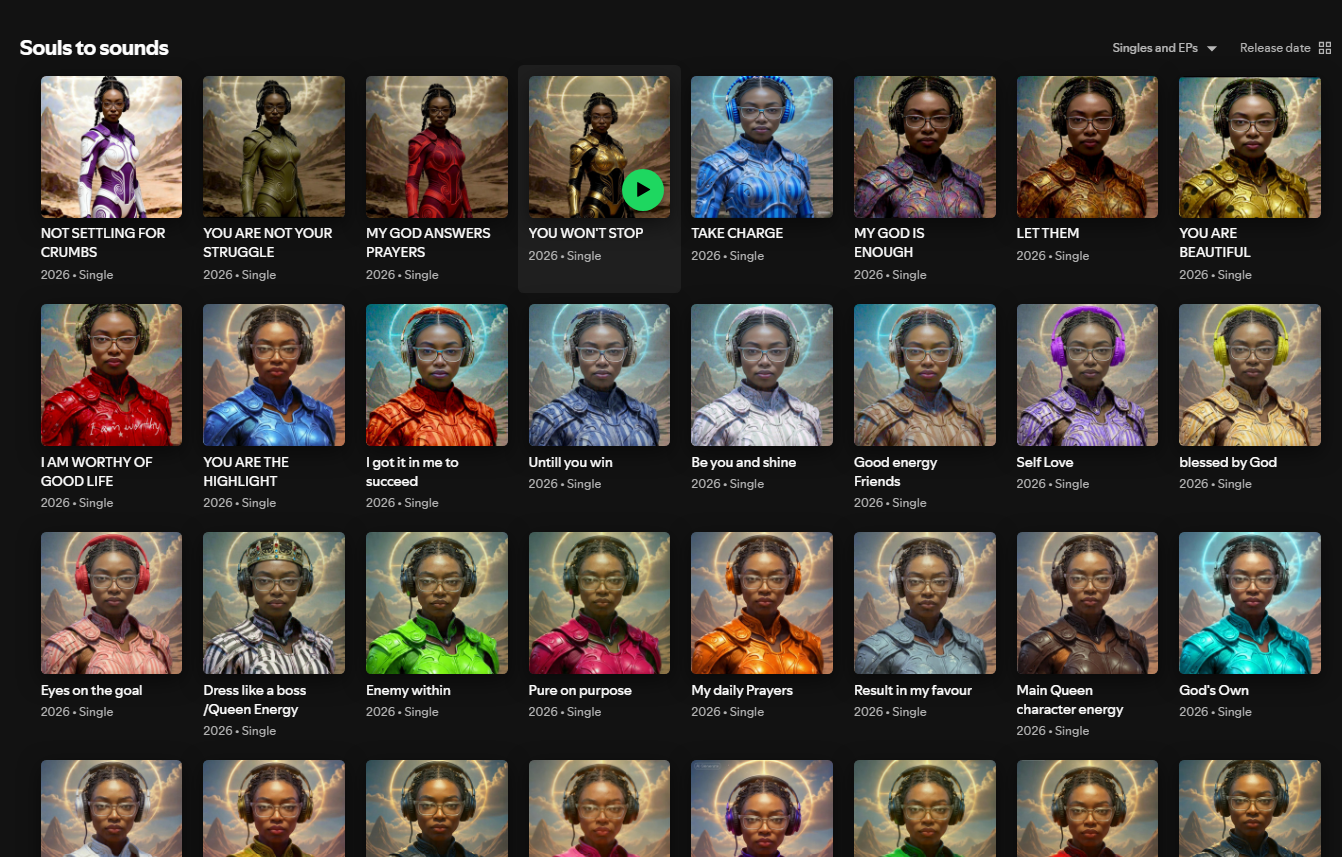
In today's streaming landscape, maximizing your chances of landing on an editorial playlist often means submitting 1 track to DSPs weeks before its release. With that being said, usually the average pace of release for an artist following this guideline would mean new music either once a month or at least twice a month.
32 RELEASES IN 6 MONTHS IS BONKERS.
From the idea to the final master, and then finishing the artwork, there is so much work that goes into completing and uploading music for an ordinary person. Generative AI platforms remove the friction and labor that traditionally come with the creation process. A study done by The University of Plymouth asked, “Is AI-generated art actually art?” – this I can’t answer, it’s a tough one – but there was a quote that stood out to me that is relevant here:
"Artificial intelligence is meant to improve people’s lives – it doesn't get artist's block, and can help save time."
It’s this very same positive aspect that allows for (in most cases) such an unnaturally high output. AI enables users to produce countless iterations of a musical idea in minutes with simple prompt adjustments. This relegates someone to become less of a creator and more of an editor or curator.
Extreme Genre Changes Without Credits
Inspiration is a breeze that has the potential to uplift our creative ideas. It’s perfectly normal for artists to follow that breeze and land up in a new sonic world. When a human artist creates music, they have a specific vocal identity. If they want to cross genres or feature completely different voices, they usually list them as feature credits. Not only for professional courtesy and royalty distribution, if it’s an artist in another genre, but also to help pull from their fan base and maximise streams.
That said, an artist whose discography veers wildly between polished 2010s pop, commercial-sounding country, and hard-hitting hip hop, all without any visible credits, is often a sign of someone swimming through Suno prompts rather than cultivating a coherent artistic identity. These releases tend to be attributed to the exact same solo artist name, with zero featured credits and no collaborations.
Vertical Wall Data
Tools like Songstats and Chartmetric are incredible for viewing and comparing data. Interestingly enough, even on these tools, it’s possible to spot an AI music project, and in this case we’ll specifically look at Spotify playlisting patterns.
Songstats has a feature that enables us to view playlist reach over a particular period of time throughout their career. Typically, the trajectory for a human artist is a gradual staircase, or even seems jagged and quite erratic. However, for an AI artist project, the common trend is that the trajectory looks something like this:
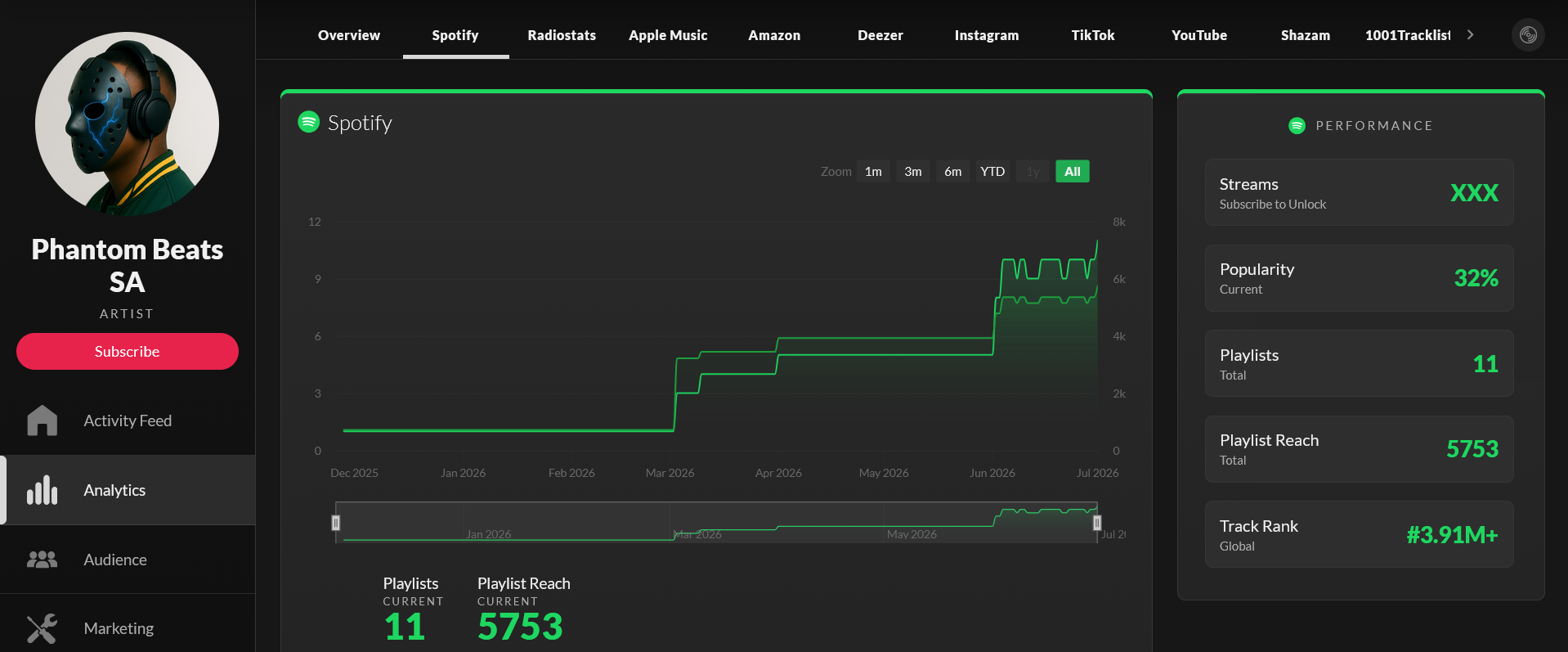
These vertical wall spikes are indicative of a bot-funded push or a click-farm campaign that’s activated to create a sense of – as the kids would say – "motion". For bad actors who run AI artists, bot farms aren't just an option - they are a core part of the business model. While a real artist uses streaming platforms to build a fanbase, some AI music factories treat streaming platforms like a pure financial extraction system.
AI Detector Tools
Should you still confused, there is actually a way to check - and this brings me back to the human curator conversation. We recently had a chat with Jason from Submit about their approach to generative AI. SubmitHub is a platform that connects independent artists with playlist curators, bloggers, and labels. Founder Jason Grishkoff built a free AI Song Checker, originally to help curators filter submissions. It analyzes a song and returns a prediction of human, hybrid, or AI. When we chatted to him about the detector, this is what he said:
"Many of the curators on SubmitHub have strong opinions about AI. We initially tested a system where artists would disclose their AI usage - but it turns out roughly 2/3rds of them were lying. So, I built the AI checker so that I could double-check. It means that I can get the right songs to the right curators - and make sure that AI creators don't end up wasting money sending their songs to those who prefer not to receive AI songs".
SubmitHub's checker mainly targets output from generators like Suno and Udio. Passing it also doesn't mean a track will pass Spotify's, Deezer's, or a distributor's own screening, since each service looks at different signals.
AI music has become a massive part of the music streaming conversation, and it's fascinating to see how DSPs are responding. Bandcamp has made an outright ban. TIDAL and Deezer have opted to block payment to generative AI music creators. Spotify has opted to label them. Apple Music has relied on disclosure. As real-life listening grows slower than the upload of AI-generated music, editors and curators will become more vital, along with fans, in drawing attention to musicians with a real-life presence.