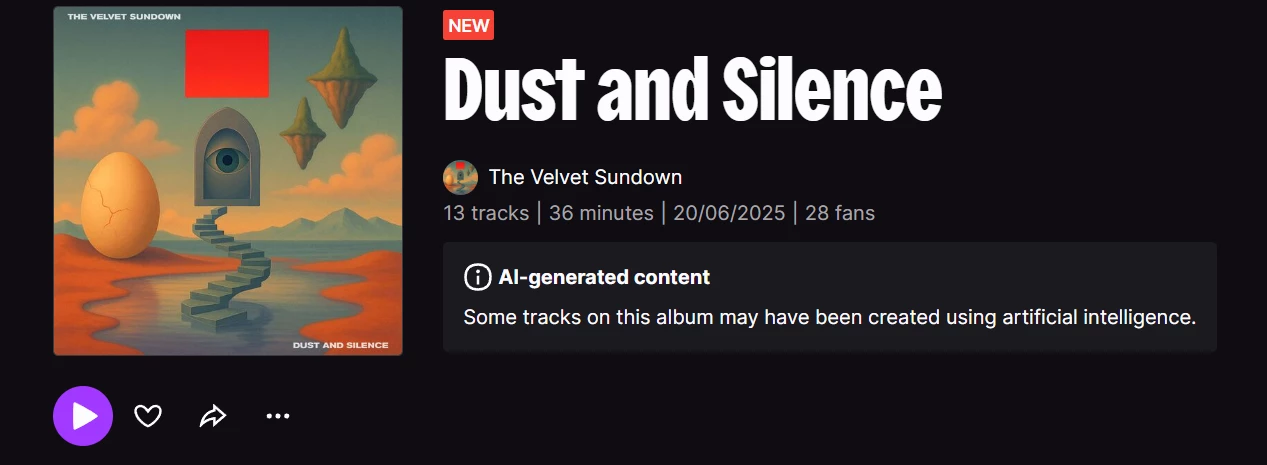
In January 2025, Deezer made an announcement that immediately turned heads within the music industry. Their new detection tool revealed that 10,000 fully AI-generated tracks arrived daily on their platform, and that they would subsequently develop a tagging system for AI music. This news not only spread far across the internet; it also felt significant as it almost felt like a warning for what's to come. And since then, AI slop has swept far beyond the music industry, while streaming fraud has evolved to become a lot more sophisticated with the help of AI tools.
Despite its rocky start, Deezer has grown to become one of the key DSPs of our time, and the manner in which they've approached the new boogeyman in music solidifies that sentiment. To dive into this further, we invited Aurelien Herault, Chief Innovation Officer over at Deezer, to discuss what led to their current policy on AI music, their distinctive detection tool, and more. Before getting to dissect the streaming platform's position on AI, it helps to look at how they've progressed over time and what their policy actually says.
A Brief History of Deezer
Ever since its inception in 2007, Deezer has spent almost two decades positioning itself as the streaming service that puts listeners and artists first. In 2006, a self-taught developer named Daniel Marhely constructed Blogmusik - a free streaming site - from his apartment in Paris. Unfortunately, French rights society SACEM shut it down within a matter of months. With the help of Jonathan Benassaya, Daniel went back to the drawing board and eventually founded "Deezer" as a licensed, legal service by 2007. Since then, Deezer has expanded across more than 180 countries and become one of the largest independent streaming services in the world.
The company stands out for its artist-centric model - an approach that pays artists based on genuine listener engagement instead of pooled stream counts. More recently, its artist-centered values have made Deezer one of the loudest voices in the industry on AI, detecting and labeling fully AI-generated tracks. This is a great segue for us to actually take a look at the policies they adhere to regarding AI.
A Look At Deezer's AI Policy
Deezer treats AI music as a question of honesty and fairness. It doesn’t proclaim that AI is inherently a bad thing, that isn't the question at hand. Through their approach, listeners aren't being misled, nor are artists being undercut through the new wave of AI music rapidly finding its way on DSPs. Fully AI-generated tracks are still allowed to make their way onto the platform, but Deezer’s detection technology picks them up and tags them with a label, ensuring listeners know exactly what they’re hearing. Their own research backs this up - a survey found that 97% of people don't know the difference between fully AI-generated music and human-made music, while 80% would like AI tracks to be clearly labeled. Not only are AI tracks labeled, but they're kept out of algorithmic recommendations and editorial playlists. Furthermore, they're excluded from the royalty pool, so they don’t dilute what real artists earn. The French company has shared its detection technology with the wider industry too, arguing that protecting artists and informing fans shouldn’t be one company’s job.
Stay up to date.
New music and exclusive updates in your inbox weekly.
Below, Aurelien Herault and I dive deeper into the topic.
What kind of issue did it pose for Deezer when there was a massive increase in AI-generated music uploads throughout last year?
The massive volume in itself doesn’t necessarily create specific issues for us, other than that it demands increased storage capacity, which we solved by not storing hi- res versions of AI tracks. The issue with AI-generated music is that it has become the main vehicle for streaming fraud.
Legitimate consumption of AI-generated music is very low on Deezer, since we’re excluding it from algorithmic and editorial recommendations, and we see that the majority of streams on these tracks come from manipulation and fraud attempts. We have a team working on preventing and neutralizing streaming fraud on a daily basis, and all fraudulent streams are immediately removed from the royalty pool so that they don’t affect payouts to real artists.
Deezer was the first platform to fully tag AI-generated music. What made you decide transparency mattered more than an outright ban?
First and foremost, we want to give our users the choice to listen to AI-generated music if they want to. It is not up to us to make the decision whether it’s good or bad, especially with AI becoming more and more common as a tool across the music industry. And an outright ban comes with a set of challenges. The detection and tagging are automatic due to the fact that we are receiving roughly 90,000 tracks per day, and it’s impossible for us to manage this manually. We have no way of knowing whether or not these tracks are from established artists that have used AI tools to render tracks that they sing or rap over, for example. So if we automatically removed all tracks detected as AI-generated, we would not only give people less choice, but also run the risk of removing music that was created through genuine creativity by human artists, but happens to include enough AI-generated elements to be detected by our tool.
In your view, what's the toughest problem generative AI creates for the music industry right now? And on the flip side, in which ways do you feel like AI offers an opportunity for artists and music professionals?
Generative AI has made it easier than ever to commit streaming fraud. Anyone can very quickly create thousands of tracks, upload them to multiple streaming platforms, artificially boost the streams, and this way take money from the royalty pool that would otherwise end up with legitimate artists. On Deezer, we have put measures in place to counteract this behavior. We exclude AI-generated music from algorithmic recommendations, so that fraudsters can’t hijack the system by manipulating streams, and end up in lean-back listening sessions of people who don’t know that they’re listening to AI music. In addition, our anti-fraud algorithms are constantly monitoring for unusual streaming behavior, and we remove all fraudulent streams from the royalty pool.
On the flip side, generative AI can most likely have a positive impact on music creation, including giving artists the ability to quickly test new ideas and concepts, as well as remixing or sampling back catalogs. As long as it’s done legally and with rights holders getting paid, there is a lot of creative potential with generative AI.
Can you walk us through what your detection tool is actually looking for? Is it analyzing audio signatures, metadata, upload patterns, something else entirely?
Our AI-music detection tool works by identifying specific artifacts left behind by generative AI models in the audio they create. These artifacts are usually inaudible to humans but can be detected by software, and are rarely found in real recorded music, which makes them a strong signal for identifying AI-generated tracks. Because these artifacts are unique to each generative model, our tool can also identify which specific AI model was used to generate the music. We are currently looking at the possibility of detecting AI elements in hybrid tracks, meaning tracks that include both AI-generated elements and human-made ones.
How do you keep the tool accurate as AI music generators like Suno, Udio, and Treblo keep improving?
Our detector relies on a mathematical model of a specific part of generative models, namely the decoder part, or the very last layers of the neural network used by all these models. That part stays seemingly unchanged as these companies instead focus on extending their training datasets and improving controllability. Therefore, our tool performance is independent of the “quality” of these models. It's only if these companies change their backbone architecture that we would have to change our approach significantly.
Based on your understanding of how generative AI music is created, what's one characteristic of generative AI music that tends to go unnoticed, yet often gives away its origins?
The kind of artefacts that we detect are completely inaudible, but is also inevitable given how these models work. Some models also tend to add recognizable reverb- like effects, but these are not universal markers anymore.
Can you explain in simple terms how removing fraudulent AI streams from the royalty pool actually benefits real artists, and where does that money go instead?
First, Deezer’s Artist Centric Payment System is different from the rest of the other streaming services, and a higher share of what subscribers pay goes to the artists they love, thanks to a number of unique mechanisms and boosts on Deezer. No matter the payment system, the amount of money is finite based on the number of paying subscribers a service has, and this pool of money is divided based on the number of streams each artist stacks up every month. So, simply put, if someone is using bots to create artificial streams, these streams will equate to a share of the finite royalty pool that would otherwise go to legitimate artists. This is why it’s important to remove fraudulent streams from the royalty pool calculations.
We exclude AI-generated music from algorithmic recommendations so that fraudsters can’t hijack the system by manipulating streams and end up in lean-back listening sessions of people who don’t know that they’re listening to AI music. In addition, our anti-fraud algorithms are constantly monitoring for unusual streaming behavior, and we remove all fraudulent streams from the royalty pool.
Some artists now use AI tools as part of a legitimate creative process, not fully synthetic tracks. Where's the line for Deezer?
Generative AI will surely be used by many artists going forward, as long as the tools are fairly and legally trained, the content is not being used for fraudulent activities, and this is not an issue from Deezer’s perspective.