We've been following Nick Marks' music for a few years now, watching him continually evolve and build on his signature cinematic jazztronica sound. A jazz-trained pianist, film composer, arranger, and producer, Nick effortlessly brings together all sides of his musical world into one cohesive journey that carries his own unique and deeply personal creative fingerprint.
With the release of his latest EP, happy place, we caught up with him to talk about the inspirations behind the project, the collaborators who helped bring it to life, and the moments going on in his life that shaped it.
Nick's answers are every bit as thoughtful as his music. Reading through them felt like a conversation I'd love to have over coffee in New York with someone who could happily talk about music for hours. So without further ado, let's dive in.
Your music feels like a meeting point between all the different roles you play as a musician - you're a jazz-trained pianist with a love for classical music, you compose for film, arrange for large ensembles, and produce in your home studio. Did that blend happen naturally over time, or was it your intention to bring those worlds together in your own work?
That's kind of you to say. I think these skills came together naturally over time, but fusing them into one unified artist project was intentional.
Stay up to date.
New music and exclusive updates in your inbox weekly.
When I look back, I think scoring my first short film way back in 2012 was the biggest unlock: it broke open what music could be sonically and texturally, beyond just the notes on a page or playing only acoustic instruments. Before that, my background was entirely in live performance and acoustic instruments. Film scoring was always a huge passion, though I had thought of it as a separate discipline. So once I got my first short film score, it was the perfect opportunity to take my training as a jazz musician into a new paradigm, which I hadn’t done before. The learning curve was steep and swift. As it turned out, transcribing and analyzing large, dense orchestral arrangements naturally progressed into figuring out how to pull elements of that into my own work. Producing skills came as a natural byproduct of film scoring, because in 99% of cases, you have to present a high-quality demo track that will convince the director "this is the music for your film”. Over time, there became a natural crossover between using my skills as an improviser in composing and my skills as a composer/arranger in making choices about how I improvise.
I’ve been fascinated and curious about different musical worlds, and my favourite artists have always been those who keep evolving, drawing on new influences and never stand still. This is something I’ve set out to do intentionally, through building jazz-infused dreamscapes that became my own artistic lane.
For a long time, I thought of these as genuinely separate roles: performer and improviser on one side, composer and arranger on the other. Living in New York and making the Cinematic Chromatics trilogy broke those walls down completely. Now I just do it all as one thing.
How did happy place come together? What inspired the EP, and what was happening in your life while you were making it?
I didn't start with a plan. The rollout campaign for Cinematic Chromatics was still in full flight, and I'd recently become a father. There was an inner need to create, but CC had been huge, resource-intensive, and self-funded. I wanted to swing back to something smaller, where I could more quickly realize a fully formed track. Becoming a father was a huge part of that: it removed any self-inhibition to wait and gave me an earned belief that I could make something homegrown at a level I could be satisfied with.
So I set up two mics on my Yamaha U3, bought a drum pack from Tamuz, and took one beat a day and improvised over it. I came up with 20 ideas. The shift in format mattered: these weren't voice memo fragments sitting on my iPhone. They were already close to finished, already in Pro Tools. I probably could have released them raw.
Listening back, at least 6 of those ideas felt undeniable. And as I listened over and over, I could hear different arrangement ideas, new harmonies, and new parts. So I took one track at a time and changed roles from performer to architect/producer/conductor.
In moments, I caught myself sliding back into the Cinematic Chromatics scale of ambition, and so I had to consciously rein it in. I'm independent; this whole project is bootstrapped by me, so the scope had to be self-imposed and disciplined.
For years, I'd listened to stripped-back versions of my tracks and thought this could work in a lo-fi setting. That's essentially what became the "B-side": a companion lo-fi release, the original raw recordings, which I've been releasing quietly ahead of the full EP under the name Unwind. It landed as its own mixtape framing, one period of time.
On a side note: one of the improvisations from that initial session turned into a track that got picked up by Bastard Jazz for their compilation, Ecology Division.
What does the title of the EP stand for, and why did happy place feel like the right name for this collection of music?
The EP title literally represents my state of mind while creating it. Every stage, from the initial improvisations to building out the structures, conceiving of the parts while taking walks, recording and arranging, is genuinely where I'm happiest (outside of being with family). I chose "happy place" over anything more clever or abstract because it's the most straightforward way of saying what’s true, no metaphor needed. The title is a statement of intent: it's about being in a certain flow state, a zone where you're drawing from all your experiences but also fully present in the now, tapping into your creativity and following your intuition.
Everything on this record is about thinking less and doing more, hence one of the other track titles: "the less i think, the more i do." I'm a pragmatic composer and producer. If something works, I run with it, and the goal is to see where that takes me next. I then follow that next idea, and then the one after and so on. The final tracks are the summation of a series of incremental steps. It doesn't aim to chase virality or reach for something esoteric for the sake of it. It's music from my own tastes and sonic palette, made for other people.
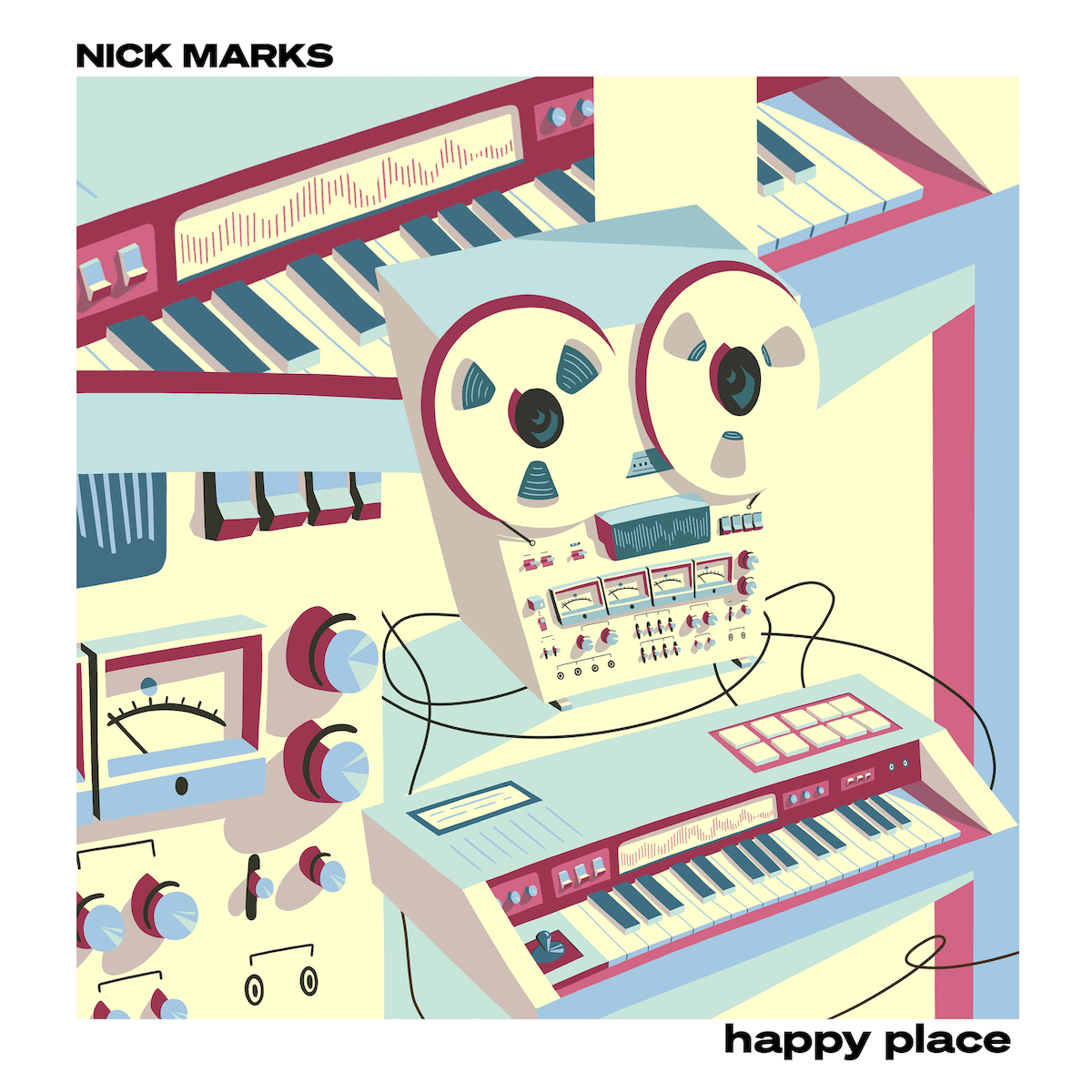
The EP brings together an incredible cast of collaborators such as Arta Jēkabsone, Doron Lev, The Untold Orchestra, and more. How did those creative relationships come about, and what made each collaborator the right fit for these tracks?
happy place is built on a core group of artists I've had strong musical connections with since arriving in NYC 10 years ago. They're phenomenal performers, improvisers, producers and composers in their own right, and their artistry hasn't just helped me grow as a player; it's shaped how I write. I tend to write with their sound in mind.
My writing follows an 80/20 rule: 80% fleshed out, leaving 20% of room for the artist to bring their own voice to the table. That's intentional. I'm not looking for people who can just shred fast. I want people who form opinions about how to elevate the music and bring something unmistakably their own to the scores. Horn players Andrew Gould, Dave Levy, Chris Ott and Stefan Haerle each bring that: real individual voices and a vocabulary steeped in jazz that moves comfortably outside it. Sarpay Ozcagatay on flute and Dave Rosenthal on electric guitar are among the most in-demand players on their instruments, both with serious writing and production chops of their own. Lavinia Pavlish is an amazing violinist with an impeccable sound who moves across genres seamlessly.
Arta Jēkabsone is a longtime collaborator, she’s been on my records and film scores. Her role on "happy place" almost never happened. We were mid-session on a different project, and I'd always envisioned her being on that track, so on a whim, I asked her, and she did it.
With The Untold Orchestra, I knew their work through their record with Bill Laurance and loved their sound. I reached out, not really expecting a response, and Josh Poole wrote back, excited about the project. We set up a session between Manchester and NYC, and the rest is history.
Your arrangements sound incredibly rich and cohesive. What's your recording process like? Do you have everyone in the studio together, or does the project come together piece by piece?
Everything starts at the piano. Usually it's free-associative improvising. That can be informed by anything happening in my life, or something that inspires me (musically or otherwise). If I come across an idea that I’m vibing with, I then intentionally hone in on the idea and listen for whatever idea comes next as a natural result. Usually I track these on my iPhone, but as I mentioned earlier, I was already recording these straight into Pro Tools. So then after that initial take, I start to be a bit of an ‘architect’ in figuring out the form and structure, where things build, where sections go. Once those tent-poles are in place, I live with the recording and start exploring/experimenting with ideas, sounds, parts in the arrangement. Once I have the track 80% (or close) to being ready, that’s when we go to the studio and record. Sometimes it’s the full ensemble, but in this case, it was in sections, both at my studio and Grand Street Recording in Williamsburg (as well as the remote session with Untold in Manchester).
How does happy place differ from your previous releases?
The Cinematic Chormatics trilogy intentionally set out to be ambitious in its scale (the ensemble size) and scope (the variety of music that I wrote). In this case, the goal was to create something with as few inhibitions as possible; minimize any friction points in going from first take to creating a track that held its own from start to end as quickly as possible. Restraint was part of the intention going into this, though I have to be real with myself in that this didn’t entirely stay restrained, given I added horns and strings! I love how these main versions turned out. Still, I kept going back to the original, more ‘lo-fi’sounding versions. Hence, I decided to create Unwind, the lo-fi sibling release, which is a real point of difference: it's the same source material in an adjacent lane I’ve never tested myself in before, even though it is aligned with my taste.
Do you have a favourite track or moment on the EP, or perhaps a track that challenged or surprised you the most while making it? I personally LOVED the synth solo on "OUI CHEF!" and can’t get the melody from “the less i think, the more i do” out of my head.
That’s very kind of you to say, I appreciate that! I love how OUI CHEF! came together. It started as a really low-key vibe, but I ended up transforming it into a soulful fusion of jazz & R&B. I’ve actually released the lo-fi version here, which is how the track started, so you can hear the evolution. This is a window into how each track on the happy place EP evolved.
I loved the recording session with the Untold Orchestra. Josh Poole did a brilliant job conducting the session. He just got the music straight away and knew how to get the sound that this record needed.
I’m so glad to have Lavinia Pavlish and Arta Jēkabsone on happy place. Initially, this track didn’t have any strings or vocals. I was trying to be ‘restrained’, but my instinct kept bringing me back to this thought: “I think there’s room for strings and vocals on this, and I know who will make the difference”. These two added another dimension to the track. I'm so grateful for their artistry and contribution. I couldn't imagine the track without their parts now, it thrills me every time.
Is there something you hope listeners take away from happy place?
This record only exists because of trusting intuition over indulging in too much deliberation and thought. The final output came after a series of incremental steps. None of which could’ve been predicted in advance. Instead, trust your gut to get you from one place to the next, and to the next, and so on. This is what leads to results, and in my opinion, they often end up bigger than you could have initially imagined. Great things can happen when you see your process through AND share the creations with the world. If you find yourself inhibited by doubt or fear, lean into the discomfort and follow what resonates with you. You’ll likely be surprised that it will connect with others, too.
What is it like living in New York? How has the city's music scene shaped you as an artist, and are there parts of New York you think show up in your music?
It’s the best! In all aspects. The good, the gritty, the tough and the glorious. New York City is home for me. In an era where we don’t have as many shared pop-culture reference points, New York itself functions as a shared cultural experience for everyone who lives here. We all understand what it is - from the ecstatic moments (see the NY Knicks) to the crazy moments to just how expensive it is - and there’s a mutual understanding of what we all go through, even though we see and experience our own version of the city. For me, this record is 100% NYC, not only because of its melting pot of musical flavours, but also for the way it was made with sweat, grit, and the generous spirit of everyone who participated in it.
If you had to choose just one role - pianist, composer, arranger, producer, or educator - which feels like the closest to you? Or are those identities impossible to separate?
I’m a composer first, followed closely by being a producer/arranger. Being a pianist is foundational to my identity, and for a long time it was the cornerstone of my identity. I don’t think of myself as only a performer, though most of my work does start with improvising. In practice, all these roles blend in the creative process, and I interchange between them rapidly. My real happy place is finding the voice of a project, then building sonic structures, telling stories, capturing moments on records, and then sharing these in live events to create memories in real time with people. I’m drawn to lush sonic dreamscapes, and also acoustic live performances; so I like to sit at the intersection where these two can meet.
And finally, what's one album or track you've had on repeat lately, and one all-time favourite you'll always come back to?
Lately I’ve been loving Mocky’s Music Will Explain; the whole record really; as well as Eric Demuro’s Simulacra. One all-time favourite I’d always come back to? Jamiroquai’s Travelling WIthout Moving or Return of the Space Cowboy.


![The New Stereofox [Oct 2026]](https://api.stereofox.com/images/148724/large.jpg?v=1791199930)