There's no shortage of music in today's world. With countless genres, styles, cultures, artists to explore, and thousands of new tracks uploaded to streaming platforms every day, music has never been so diverse, vibrant and accessible. But with so much out there, what actually captures our full attention? What makes us connect to a piece of music, grow fond of an artist, and eventually become fans? Is it purely the music, or is there something more?
Think about your favourite artists. Perhaps you just really love their music - their voice, instrument skills or approach to music really speaks to your musical ear. But maybe you also feel drawn to parts of their personality, style, visuals, and performances. You might find something in their lyrics or personal story that resonates with your own experiences. Or you randomly ended up at their gig because your friend dragged you, and that actually turned into one of the most memorable performances you have ever seen.
That’s where we start talking about more than just the artist’s music, but also the way they present it to their audience.
What Is Artist Branding?
Of course, your music should always come first, but in today’s industry, being an artist also means presenting your work to the world in a way that makes you stand out. Whether you’re a musician, producer, or songwriter, if you want to make a career from your art, you inevitably step into the role of building a brand, a business, and you need to think of ways of making your work understandable, discoverable and distinct from others’.
Branding helps people quickly understand who you are, what you offer, what makes you unique, and why it matters to them - or why they need to listen to your music, purchase your CD, or come to your gig. It’s kind of like your packaging - what people see before or after they hear your music, or what might make them press play in the first place.
Stay up to date.
New music and exclusive updates in your inbox weekly.
A silly example - I think of walking into a shop full of chocolate bars. Most might taste great, but before you’ve tried any of them, the packaging might help you decide what to pick up. It communicates flavour, mood, quality, intention, and the business behind the product through design, colour, shape, and language. Different people feel drawn to different types of wrapping - some people go straight for a bold, dark, minimal wrapper, others choose something playful and bright (and it’s probably my favourite popping candy flavour). But that packaging helps us make a choice and signals what experience or flavour to expect.
Aspects of Branding
- Musical identity: artistic role (vocalist, instrumentalist, producer, songwriter, etc), genres, influences, musical approach and performance presence (live gigs, studio work, streaming).
- Personality and values - what matters to the artist, both creatively and personally, and the topics they're interested in beyond music.
- Visual identity - clothing, photography, videos, colours, artworks, design and stage design.
- Storytelling and communication – personal stories, lyrics, captions, interviews, communication style and interactions with fans.
- Audience experience – live performances, social media and other communication channels, and how people engage with the artist's work and experience it.
Of course, the list can be longer, and these aspects of branding don't exist in isolation. Instead, ideally, they overlap, influence one another and come together to communicate the artist’s full identity.
So, how do artists decide who they want to be and how they want to present themselves to the world?
There are countless ways to approach artist branding and experiment with different creative formats, communication channels and modern technology. But there's one aspect we're particularly interested in exploring in this article: authenticity. How can an artist build a brand that genuinely communicates the personality, values and intentions behind their work? And how does this shape the way audiences perceive and experience their music?
To help us unpack these questions, we've invited Debora Saveriano, founder and creative director of OUMA, a creative house specialised in visual identities and art direction for music, fashion, culture, and experience-driven brands. She takes us behind the scenes of her work, sharing her perspective on building an artist's identity and why authenticity can make a difference.
Does Authenticity Still Matter in Music?
Hi Deborah, I hope you’re well. We’re glad to have you join us on this topic. To start, could you tell us a little about yourself, your role at OUMA, and what drew you to working with artists in the first place?
Thank you for having me! I'm Debora, founder and creative director of OUMA. We build visual identities and creative direction for producers, musicians, and the brands that live around music, fashion, labels, festivals, venues, and academies.
What drew me to work with artists is the intimate relationship and conversation that emerges when they share their world, their story, heritage, beliefs. It goes beyond a marketing list, and it’s the foundation of everything we design after. This is what I value most in my work with them.
OUMA's work on the creative vision of The European Music Agency
Do you typically work with a particular type of artists?
It’s definitely diverse. We've worked with contemporary composers, house and electronic producers, DJs, rappers, and singers. Brands we work with also vary, from record labels to festivals and academies. It’s a beautiful and interesting mix.
What they have in common is a desire to co-create a narrative that is real to them, and let it guide all the visual choices from graphic identity to photography direction and content. At the core, what I am after is the message they’re carrying. Heritage, meaning, a scene, a point of view they're not willing to sand down to be more palatable. Those are the projects where our process actually has something to work with.
Do you mainly work with emerging artists who are building their visual identity from scratch, or with more established artists looking to refine and evolve an existing brand?
We've worked with more established artists so far, but we have some experience with emerging artists too. They're genuinely different works.
With an emerging artist, you're on a blank page, which sounds freeing and is actually quite exposing. There's no evidence yet. You're working from instinct and who they're becoming, and you have to build something with enough room in it that they don't outgrow it too early.
With an established artist, there's an archive. Years of music, gigs, press shots, videos, merch, reputation, things that worked and things they now wince at. We explore what changed in them, why “now” is the moment of change or evolution, and decide what to keep and what to create new. Some artists arrive at a threshold - a new album, a label move, a change in the music itself, a desire to speak to a new crowd or industry, or to shift the perception of them.
With artists, it’s hard to build something that won’t change in a few years. As humans, we constantly evolve, we’re influenced by what surrounds us and the experiences we live, but the beliefs and values of somebody stay at the core. That’s what we help artists define and translate into a visual world that can last, while leaving room for it to expand and transmute.
When you begin working with a new artist, where do you start? How do you get to know who they are creatively before making decisions about visuals? Are there any exercises or questions you encourage artists to explore beforehand?
We start by listening properly, with no visuals anywhere near the table. Then we go into what we call the Sonic Portrait, a reflective exercise for the artist, which they take away and sit with in their own time. It moves well outside music, considering their story, influences like cinema, art, texture, memory, legacy, and what they want to leave, doing what they do. I read the most amazing, thoughtful, and honest answers, and those are for us to bring into the building of the story and the creative direction. Our work extends to styling direction, content pillars, and graphic identity, soon expanding further to offer brand partnerships as a natural extension.
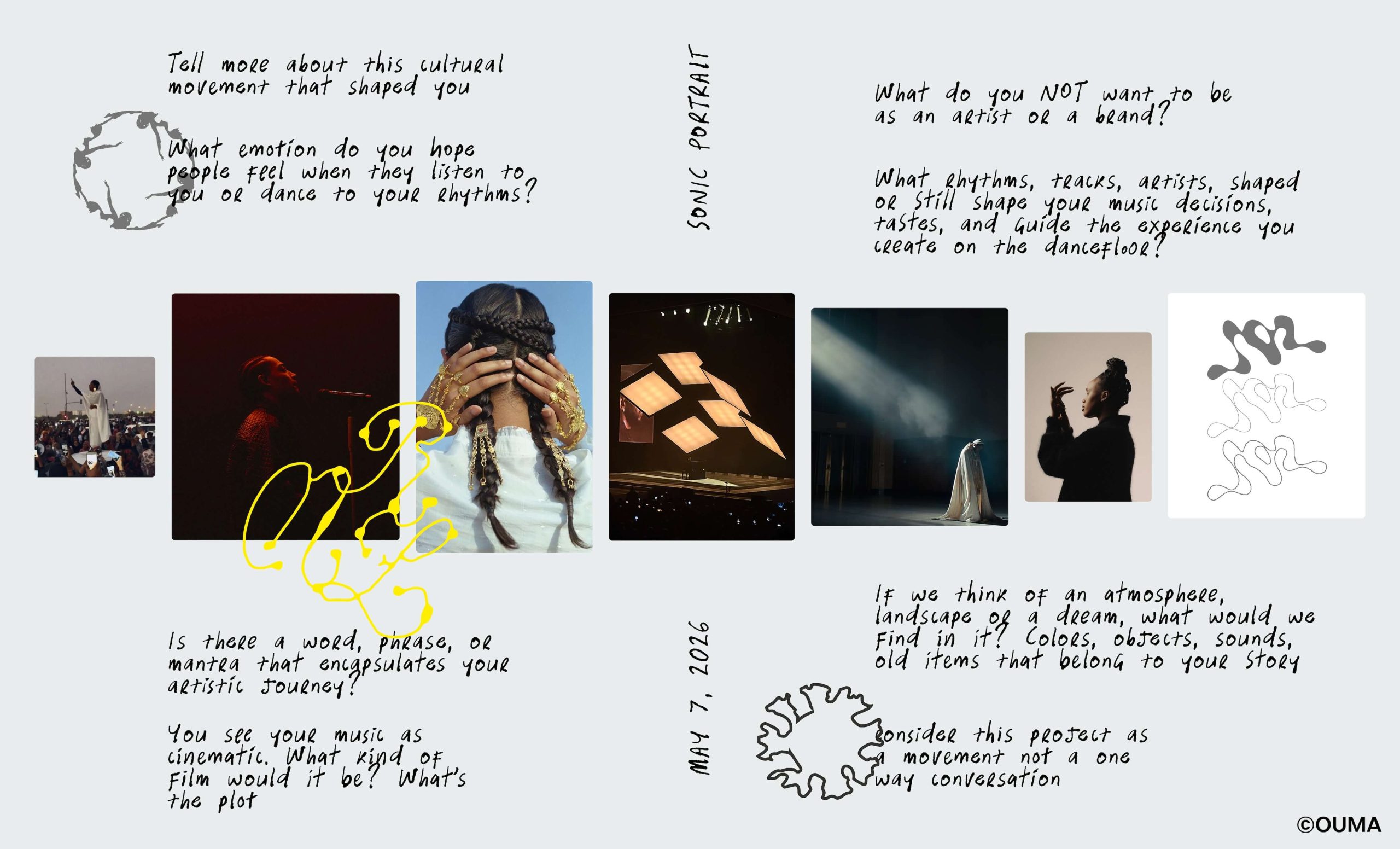
A sonic portrait example
How collaborative is this process between you and the artist?
It’s always a dialogue rather than a one-way input. We are deeply inspired by the artists we work with, and it’s important to include them in the process by actively listening, sharing, and talking things through. There is also independent studio work to be done between us creatives, where we research, sketch, experiment with different territories, and talk as a team before filtering and presenting.
Artists tend to arrive in one of two states. Some have a completely clear vision, and part of my job is working out whether it's truly theirs or there’s something else we can uncover, and challenge them when I see opportunities from a different lens. Others say they have no idea, they're not visual, they'll leave it to us. That's hardly ever true. Artists are deeply creative - they have an instinct, but they just haven't been given a way to describe it or find the answers. I would say that in both cases there is room to question, challenge, and explore the vision together - sometimes it turns out to be aligned with what we initially thought, and sometimes the outcome is unexpected.
In your experience, how do you build a strong visual identity without losing authenticity?
By finding an actual connection between the self and what’s put out there, what you want to share with the world in that moment in time, how you show up, and the decisions you make, not just visually but holistically. Authenticity comes from your own stories, beliefs, and integrity. This can be portrayed by a raw, analogue visual world or by a complete AI artistic vision. The outcome alone doesn’t mean more or less authenticity, as long as the story and the beliefs are met and genuinely carried over.
We should never confuse authenticity with the absence of craft or technology.
There's a belief that anything designed, styled, or art directed is somehow less real. But everything an artist does on a stage is constructed. Lighting, setlist, styling, visuals. What matters to me is what you're constructing it from. If the material comes from their actual life, their learnings, their obsessions, or a concept that is close to a moment the artist is experiencing, or a message they want to share.
If an idea comes from what's performing well on the internet and you have nothing to do with it, or you partner with a fashion label you don’t share values with, and pick this road instead of actually thinking of your message, that is the definition of what’s not authentic to me.
Why do you think authenticity matters in today’s music industry?
It’s the only sustainable way, I believe. Fans are looking for a connection beyond music, and it’s hard to maintain that connection if we’re pretending to be someone else. For the artist, it's equally important to think about what they're actually made of, what they believe in, and how they can communicate that to their fans, visually and holistically. Music will always come first to me, but it's inevitable not to think of how to share who’s behind it on some levels. You choose what people have access to, of course.
A borrowed identity is exhausting to maintain, because there's nothing underneath it telling you what to do when a new situation comes up, there’s no integrity. One built from who you actually are makes decisions easier, not harder. That's the real argument for authenticity. It isn't a moral position, it's the only thing that's sustainable.
Can you think of an artist whose visual branding really feels authentic to you? What makes it work so well?
Bridge is a DJ we’ve worked with whose identity I often come back to as an example. What makes it feel authentic is that it doesn’t begin with the question, “How should she look?” but with what she stands for and the kind of space she wants to create around her. Her work is deeply connected to Black house and dance music, education, freedom, and the idea of the dancefloor as a place where people can fully be themselves and form community. There is a clear relationship between her values, the music, the people around her, and the way she communicates visually. Nothing needs to be added simply because it is fashionable or performing well online. She puts a lot of work into keeping those different parts aligned and meaningful. If something performs well as a result, that becomes a consequence rather than the starting point.
OUMA's work on the creative vision of New York DJ Bridge
Solange is another clear example. Music, fashion, architecture, choreography, landscape, and cultural history all feel as though they belong to the same sensibility. When I Get Home, for instance, wasn't simply given a Texan aesthetic; Houston, the Third Ward, Black cowboy culture, futurism, and ideas of home were embedded in the work. Her visual world gives Black cultural memory, spaces, and rituals the scale and consideration they deserve.
Fred again.. arrives at something almost opposite visually, but with equally strong internal logic. His world is built from ordinary life: phone footage, voice notes, conversations, memories, imperfections. He has described Actual Life and the live experience almost as a collaborative diary, even bringing material from audiences back into the shows. The point of view is that everyday human moments are worth noticing, and the audience is part of the story rather than standing outside it.
Stromae is perhaps one of the clearest examples of building an entire creative system rather than simply an artist “look". Through Mosaert, music, graphic design, photography, video, stage costumes and fashion were conceived as connected expressions of the same identity. Even the clothing grew directly out of the visual language developed around the music and performances. The point of view is that a song, an image, a garment and a stage can all be different manifestations of the same creative language.
Robyn is a different kind of authenticity again. There is this ongoing coexistence between emotional vulnerability and complete creative autonomy: heartbreak, longing, and insecurity can live inside incredibly euphoric pop music. And her independence isn’t merely an aesthetic attitude; she actually created her own label and restructured her career to regain creative control. So underneath the changing records and visuals is a consistent belief that strength doesn’t require hiding vulnerability, and independence means having the freedom to express both.
Kendrick Lamar interests me because the visual language is so often driven by storytelling rather than decoration. Personal history, Black American experience, success, contradiction, and ideas around America itself become characters, environments, choreography, and symbols. Even something as large-scale as the Super Bowl performance used a deliberately restrained visual system so that dialogue, movement, and narrative could remain central. The point of view is that identity doesn’t need to be simplified into a perfectly resolved image, as history, contradiction and questioning can become the central work.
Then there are artists whose sense of authorship is inseparable from cultural heritage. I’m a huge listener of Mali blues and the wider West African region. Fatoumata Diawara, for instance, has spoken about not needing to abandon her roots in order to present her culture in a new way. She carries Wassoulou and Malian traditions into contemporary forms while also using the work to question aspects of tradition, particularly around women. Her point of view is that respecting where you come from doesn’t mean preserving it untouched; heritage can move forward with you.
They are all very different, but they share an internal logic behind their choices. For me, the strongest artist identities don’t just create a recognisable aesthetic; they create a recognisable point of view. You understand what world you are entering, what it values and who it is for. The visual world isn’t just recognisable because it repeats the same aesthetic; it is recognisable because there is a point of view underneath it.
What are some common mistakes you see emerging artists make when developing their visual brand? Are there any trends you wish artists would avoid?
It’s totally healthy in my view to make mistakes, especially as emerging artists, while learning who you are and what you want to pursue. There are things I’d say are more harmful than others when building your identity:
- Building for the algorithm rather than the audience or borrowing from the artist one tier above you. It's understandable, they're visible, it clearly works, but you inherit their story rather than telling yours.
- Investing in the logo and neglecting everything else. Most artists are experienced through their whole personal brand and artistic world.
- Leaving visuals until two weeks before a release. At that point, you're producing assets, not building anything.
- Skipping the excavation we spoke about in the previous answers is in my opinion what should be considered at some point in their career.
How important is consistency in visual branding, and how can artists stay visually coherent while still allowing themselves to evolve?
Consistency is essential, but I think it is often confused with sameness.
I tend to think about it as constants and variables. The constants are the deeper codes: your beliefs, your point of view, and the elements of the identity that express those most clearly. The variables are everything that can shift from project to project, era to era, or record to record. If you get that relationship right, you can evolve quite dramatically without losing a sense of authorship. And sometimes a complete change of direction is exactly what an artist needs, particularly when an older perception no longer reflects who they are. The important thing is that once new foundations are established, you give them the time and consistency to become recognisable and credible.
I also think there is something to be said for staying with an identity long enough to really inhabit it. If you have invested in understanding your world and building it properly, allow yourself the time to live inside it, experiment with it, and let people experience it repeatedly. One post performing less well, or a few quiet months, does not tell you whether a brand is working. Recognition is built through accumulation. It comes from showing up with intention over time, across imagery, content, performances, collaborations, and the places you choose to be present. A creative director or manager can help define the foundations and give the project structure, but the artist also has to keep bringing that world to life. The identity becomes powerful when it is not only designed well, but lived consistently enough for people to recognise it as yours.
Have you seen good visual branding make a tangible difference to an artist's career? For example, in attracting listeners, industry attention, live opportunities, or press coverage.
Yes, although I’d be careful about suggesting that visual branding alone creates opportunities. The music and the work have to be there first. What a strong visual identity can do is make it much easier for people to understand, remember, and talk about an artist. For independent artists especially, I think it can also change the way they see themselves. When the visual world genuinely represents who they are, they often feel more confident showing up, communicating, and putting themselves forward. There is a stronger sense of, “this is me, this is my world, and this is where I belong.”
For an emerging artist especially, people are often encountering you through fragments: a track appears on Spotify, someone sends them a Reel, they see a poster, a press image, or a live clip. When those fragments feel connected, they start accumulating into a world rather than disappearing as isolated pieces of content. That can absolutely affect perception. It can help a journalist understand the story they are covering, give a promoter a clearer sense of where an artist belongs, or make a collaboration or brand partnership feel more natural and credible. It can also help the artist become more intentional about where they show up. Instead of placing themselves everywhere simply for visibility, they can start recognising which platforms, venues, publications, collaborators and opportunities genuinely belong to their world.
The value isn’t about making an artist look bigger than they are. It is about making who they already are easier to recognise, to themselves first, and then to everyone else.
Finally, what advice would you give to an emerging artist who's still trying to figure out their creative voice and visual identity? What's one thing they could start doing today to better understand how they want to present themselves to the world?
For emerging artists, I would say: start collecting before you start designing.
Create an archive of things that genuinely mean something to you, and don’t limit it to other artists. It could be a scene from a film, your grandmother’s house, a photograph you took ten years ago, a club flyer, a memory, a place, a piece of writing, even something you dislike. Save it, and more importantly, write down why it means something to you. After a while, patterns start appearing. The same emotions, tensions, colours, subjects or ideas begin to return, and that can tell you much more about your creative voice than searching Pinterest for “artist branding inspiration”.
I think the same applies to AI. AI can help you organise, articulate or refine what you have already discovered, but it can’t do the noticing for you. The story, the references and the point of view have to come from somewhere real first. Otherwise, it's very easy to end up with a collection of ideas that sound convincing but could belong to almost anyone.
You also don’t need to invent a persona unless there is a real reason to do so. Pay attention to yourself, the world around you, the way you make music, what you keep returning to, and what genuinely moves you. Often, the beginnings of the identity are already there. The work is recognising them, understanding why they matter, and deciding what you want to amplify.
So, Does Authenticity Still Matter?
We think it does, perhaps now more than ever. Being authentic doesn't mean having to publicly reveal everything about yourself or stick to one particular image. It's about finding ways to express your creative vision, personality and values that feel genuinely your own. In an industry where trends come and go and artists are constantly encouraged to find new ways to stand out, having a clear sense of who you are and what you want to communicate can be an important foundation for building a sustainable identity and career.
And what’s more - in our increasingly digital and fast-paced surrounding world, people crave honesty, creativity and genuine connection. We want to feel something real. We want to connect with others, feel like a part of their stories and find a sense of belonging within a community. Perhaps that’s not true for all, but as long as there are people who resonate with this, and I’m sure there are a lot, authenticity will matter. And I have a feeling that, since you made it to the end of this article, you might be one of them.